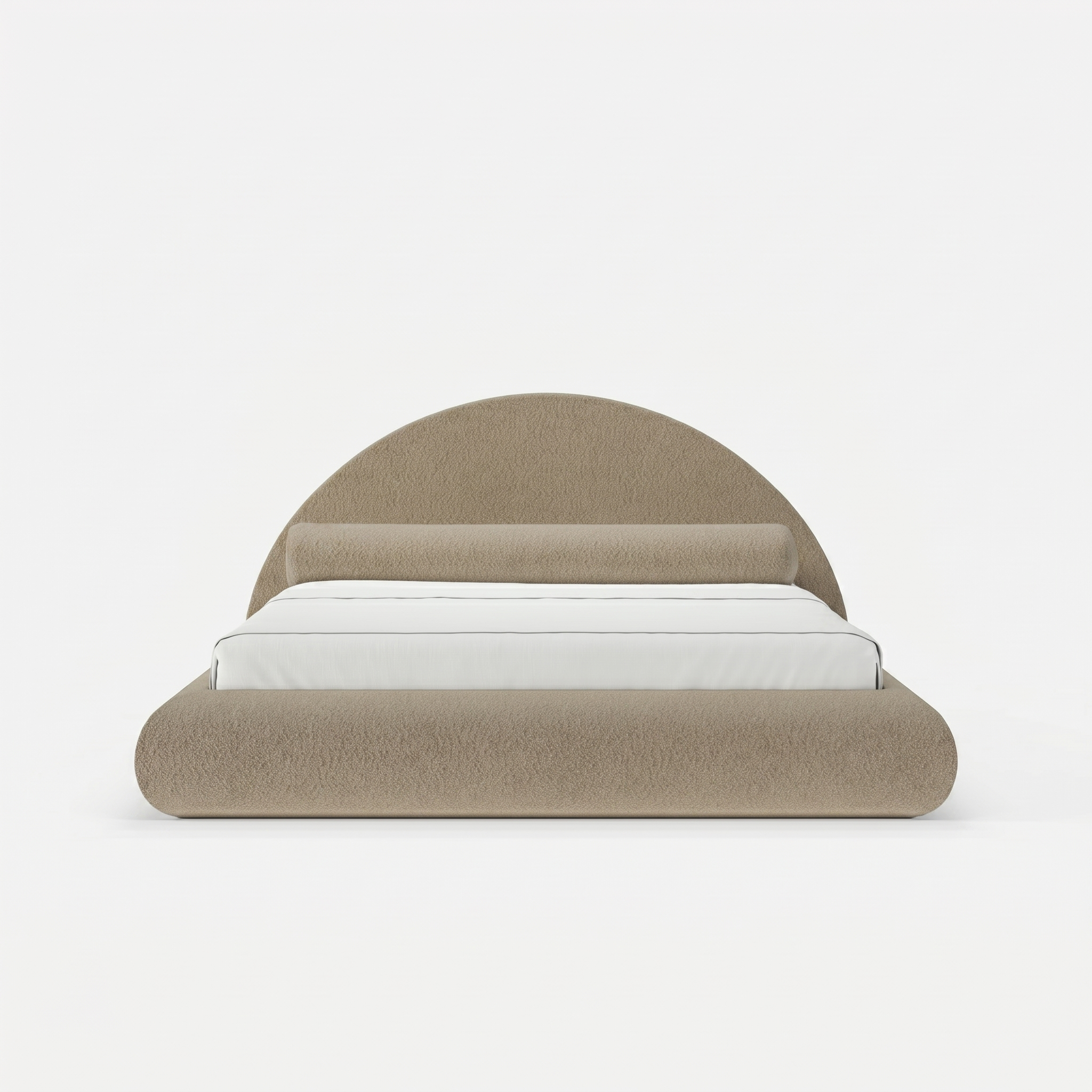
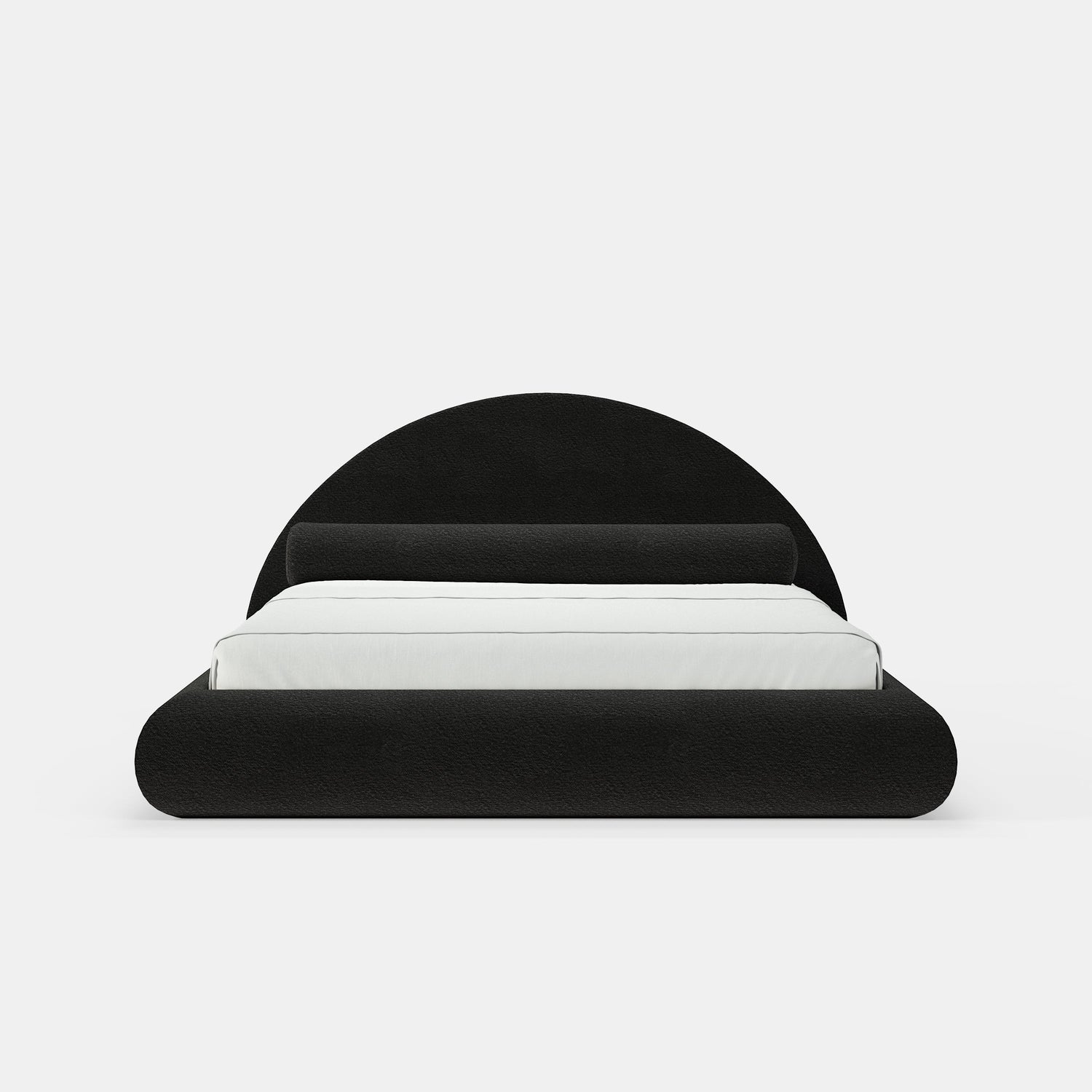
You have probably seen one before you knew what it was called. A wide, low bed sitting flat on the floor, with a thick headboard wrapped entirely in fabric. No legs. No wooden frame. Not one hard edge.
Depending on who is showing it to you, it is called a cloud bed, a marshmallow bed or, in French, a lit nuage. Three names, one object.
A bed that came from the United States
The idea comes from American bedrooms. Beds there have been moving towards the floor for a long time: lower, wider, with no visible structure. What came next was the foam. The whole bed, headboard included, became one soft block wrapped in fabric.
The result no longer looks like furniture. That shift is where the nicknames come from.
Why three names
Cloud bed describes what you see: a pale, full mass with no feet and no hard lines, that looks placed rather than built.
Marshmallow bed describes what you feel: a surface that gives under your hand and comes back. Hence the sweet.
Lit nuage is simply the French translation that stuck. It is the term you will meet most in Belgium and France.
None of the three is a brand. They are descriptions.
What actually makes a cloud bed
Four things. If one is missing, you are looking at something else.
1. All foam
The headboard and the border are foam, not padded wood. It is the most important difference, and the least visible in a photo.
2. On the floor
The base touches the floor. Nothing goes underneath, so there is no gap to clean and no leg to catch your foot on at night.
3. No frame, no legs
No rigid structure around the mattress. The foam border runs all the way round, and it is what holds the shape.
4. Wrapped completely
Fabric covers the whole thing, without a break. That is what gives the continuous, single-piece silhouette.
What it is not
A padded headboard mounted on a standard frame is not a cloud bed: the shape comes close, the construction does not. There, fabric is covering wood.
Nor is a mattress on the floor. That is missing the border and the headboard, which is to say everything that makes the silhouette.
The detour through Japan
The American shape is generous, sometimes heavy. What we kept is the Japanese line: low, full, without a single hard angle, restrained rather than domed.
That is where the name of our beds comes from. Mochi is a Japanese rice cake, dense and soft, whose surface gives without hollowing. The comparison says more than marshmallow about what good foam should do.
Round headboard or straight
Two silhouettes, one construction.
The Cocoon has a half-moon headboard. It is the softer version, the one that rounds off an angular room.
The Frame has a rectangular headboard with softened corners. More graphic, it holds better in a room that is already strongly drawn.
There is a kids version too, built the same way, and a dog basket on the same principle.
Seeing one for real
A cloud bed is judged by hand more than by eye. Several models are on show at our depot near Brussels, with the fabrics to touch, by appointment.
All ten fabrics are laid out side by side there, under the same light. It is the only honest way to compare two beiges.